

ENERGY GUIDE
Energy Efficiency and Smart Lighting Control
Where lighting control actually saves money — and where the numbers don’t add up.
By RunLessWire | August 2026
Lighting is one of the largest and most controllable pieces of your home’s electricity bill. The Department of Energy puts residential lighting at roughly 5 to 10 percent of total household electricity use. LEDs cut that number dramatically, but the next lever is control: turning lights off when they’re not needed, dimming them when full brightness is wasteful, and making both of those things easy. Here’s where the real savings live.
1. LEDs Are the Baseline, Not the Finish Line
If you’ve already swapped incandescents and CFLs for LEDs across your home, you’ve captured most of the easy energy win. An LED uses roughly 75–90% less electricity than an incandescent for the same brightness, which is why bulbs stopped being where the real money is. From here, additional efficiency doesn’t come from a marginally better bulb — it comes from using the ones you have less.
2. The Biggest Win Is Making It Easy to Turn Off
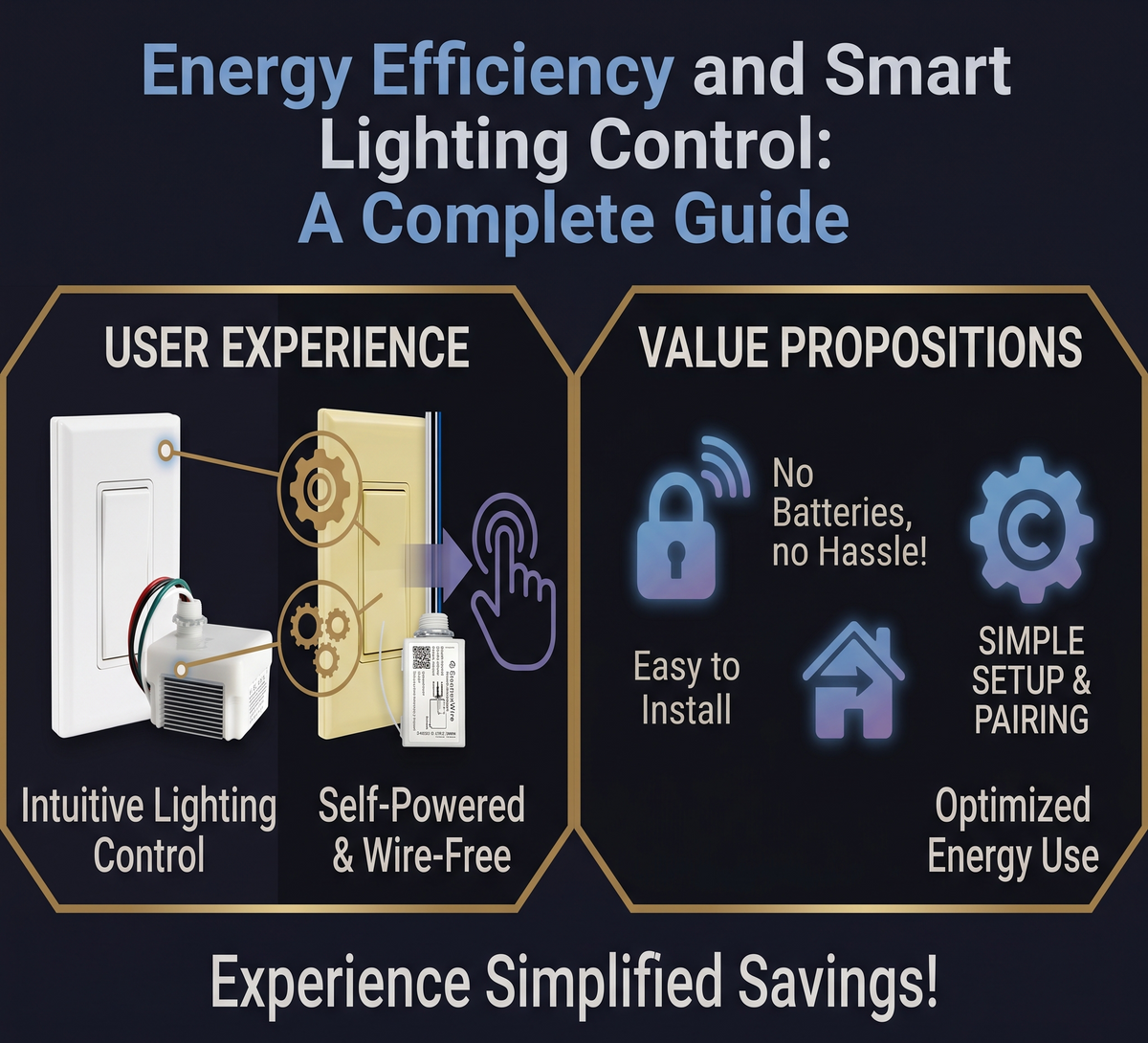
Every energy audit reaches the same conclusion: the fastest way to save on lighting is to leave fewer lights on. Sounds obvious, until you count how often you don’t turn something off because the switch is inconvenient. RunLessWire Wireless Switch Kits put a control wherever you actually are — bedside, next to the couch, at the top of the stairs — without any wiring. One press is a habit; a walk across the room is not.
3. Dimming Actually Saves Wattage
Dimmable LEDs draw less power in proportion to the light they output — dim a 60W-equivalent bulb to half brightness and its actual wattage drops accordingly. Over a year of evening use, running your living room at 50% instead of 100% shaves noticeable money off the room’s lighting bill. It also extends bulb life. A dimming receiver on a fixture you use often is one of the highest-ROI upgrades in the room.
4. Occupancy Sensors for the Rooms You Forget
Some rooms — closets, pantries, laundry rooms, garages — get lights left on for hours because nobody remembers to flip the switch on the way out. Occupancy sensors solve this with pure automation: the light turns on when you enter and off after a set delay when you leave. For a walk-in closet used a few times a day, that can be the difference between an all-day burn and 20 minutes of actual use.
5. The Hidden Standby Cost of Smart Switches
Here’s the twist most efficiency guides miss: many Wi-Fi and hub-based smart switches draw 1–3 watts continuously to maintain a cloud connection. Multiply that across a home and you can add $20–$60 a year to your bill in standby power alone. Kinetic wireless switches skip most of this — the switch itself is genuinely off between presses, and the receiver’s low-power radio draws far less than a Wi-Fi connection. The savings from turning lights off shouldn’t be eaten by the switches turning them off.
6. The Right Bulb + The Right Control = The Real Savings
None of these strategies works in isolation. LEDs alone still get left on. Timers can’t save you from a heavy-draw incandescent. But layering the fundamentals — good bulbs, sensible schedules, dimming where it fits, controls where you actually are, and switches that don’t pull power themselves — adds up. Each individual saving is modest. Together, they meaningfully change the number on your bill.
Small Wins Compound
Energy-efficient lighting isn’t a single upgrade you buy once. It’s a set of small decisions — bulb, control, dimming, sensor, placement — that stack. The homes with the lowest lighting bills got there by combining several of these, not by chasing the single perfect device.
Every RunLessWire product is engineered and assembled in the USA, backed by a 5-year warranty — and because our switches are self-powered, they never add a watt of standby draw to your bill.
No wires. No batteries. No limits.
Ready to turn off what you’re not using?
Explore our full product line at runlesswire.com
or find us on Amazon and Home Depot.

Leave a comment
All comments are moderated before being published.
This site is protected by hCaptcha and the hCaptcha Privacy Policy and Terms of Service apply.