

BUYING GUIDE
How to Choose the Right Dimmer for Your LED Bulbs
Five questions to answer before you buy — so your lights dim smoothly instead of flickering, buzzing, or cutting out.
By RunLessWire | September 2026
Dimming used to be simple: buy a dimmer, install it, done. LEDs changed that. They use a fraction of the power, last for years, and look great — but they’re pickier about what they’re paired with. The good news is that choosing the right dimmer doesn’t take an engineering degree. It takes answering five questions in the right order, starting with the bulb instead of the switch.
1. Is the Bulb Actually Dimmable?
Start here, because nothing else matters if the answer is no. Look for the word “dimmable” on the packaging or the bulb’s base. Non-dimmable LEDs will flicker, hum, or refuse to dim on any dimmer, no matter how good it is. If you’re mixing bulbs on one circuit, every single one needs to be dimmable — one non-dimmable bulb can drag the whole fixture down with it.
2. Line Voltage or Low Voltage?
This one question decides which family of dimmer you need. Screw-in bulbs, recessed cans, chandeliers, and most ceiling fixtures run on standard 120V line voltage. LED strip lights, tape lights, under-cabinet runs, and many landscape fixtures run on low-voltage DC — usually 12V or 24V — supplied by a separate driver. A line-voltage dimmer won’t properly control a low-voltage strip, and vice versa. Check the fixture or driver label before you shop.
3. What’s the Real Wattage?
Add up the actual wattage of every bulb on the circuit — not the “60W equivalent” printed in large type, but the real number, usually 8 to 10 watts per bulb. Then check that total against both ends of the dimmer’s rating. Most people only look at the maximum, but dimmers have a minimum too. A single low-wattage LED on a dimmer built for big incandescent loads often flickers or drops out at the bottom of the range.
4. How Smooth Does It Need to Be?
Not every dimmer handles the low end gracefully. Cheaper models can step visibly between levels or cut out entirely below 20 percent. If you plan to dim a bedroom or living room way down in the evening, smoothness at the bottom of the range matters more than anything on the spec sheet. For line-voltage LEDs, look for dimmers rated for LED loads — trailing-edge designs are generally the gentlest. For low-voltage strips, look for high-resolution PWM dimming.
5. Where Do You Want to Control It From?
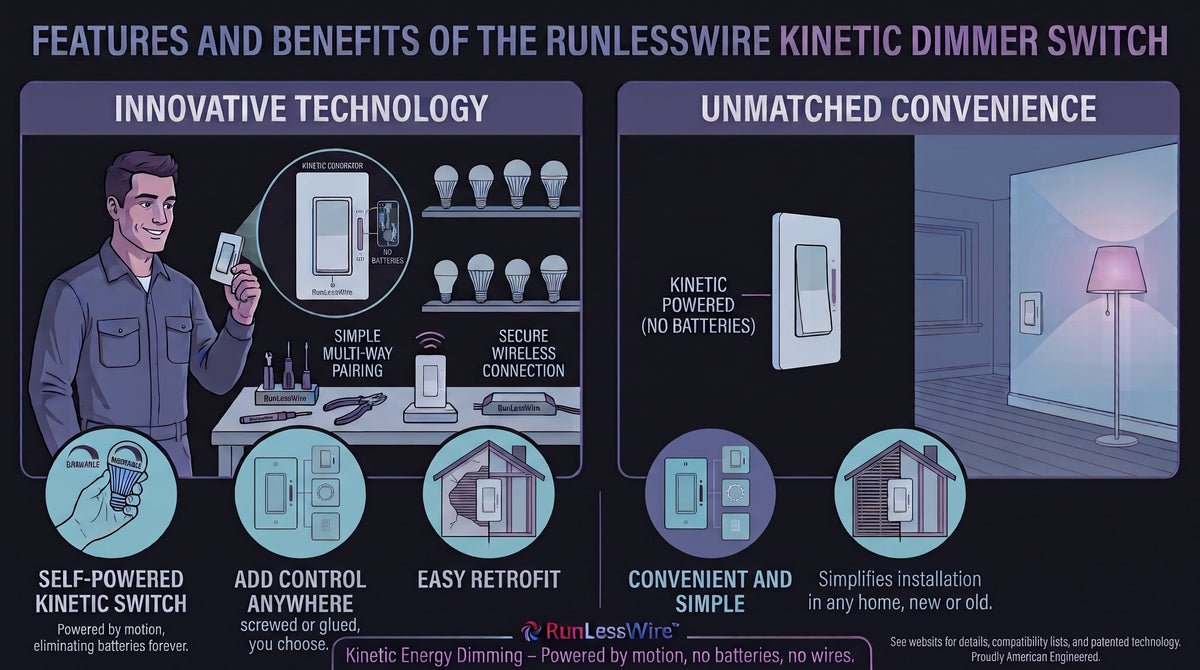
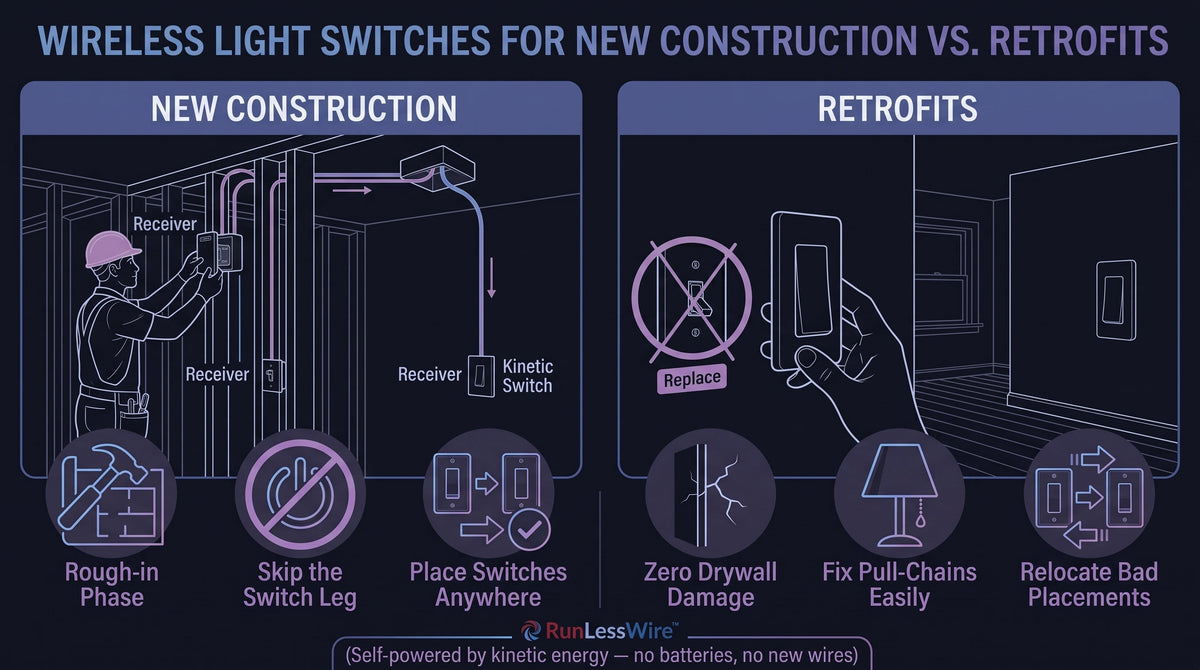
The last question is the one most people skip: where will you actually reach for the dimmer? A wall dimmer only helps if it’s in the right spot. With a wireless setup, the dimming happens at a receiver near the fixture, and self-powered switches go anywhere — bedside, beside the couch, or at both ends of a room. Press briefly to turn on or off; hold to dim up or down.
Matching RunLessWire Receivers to Your LEDs
For line-voltage fixtures — chandeliers, recessed cans, track lighting, dimmable LED bulbs — the 120VAC Phase Dimming Receiver is the right pick. For LED strips and other 8–30VDC systems, the Low-Volt Dimming Receiver uses 65,000 PWM dimming steps for genuinely smooth transitions at every level. Both pair with any RunLessWire wireless switch. Browse the full lineup of Wireless Switch Kits to find the right combination.
Get It Right the First Time
Dimmable bulb, right voltage family, wattage inside the range, smooth low-end performance, and a control where you’ll actually use it. Answer those five and dimming stops being a gamble.
Every RunLessWire product is engineered and assembled in the USA, backed by a 5-year warranty, and built to last 20+ years.
No wires. No batteries. No limits.
Ready to dim your lights the right way?
Explore our full product line at runlesswire.com
or find us on Amazon and Home Depot.


Leave a comment
All comments are moderated before being published.
This site is protected by hCaptcha and the hCaptcha Privacy Policy and Terms of Service apply.