

DESIGN GUIDE
Wireless Light Switches for New Construction vs. Retrofits
Two very different jobs, one very versatile solution — how wireless switches earn their spot in both.
By RunLessWire | September 2026
There’s a persistent myth that wireless switches are “only for retrofits” — a fix for homes where opening walls isn’t an option. It’s half right. Retrofits are where wireless shines brightest, but new construction is quietly catching up. More builders and architects specify wireless switches at the design stage because they solve problems traditional wiring creates. Here’s how wireless fits into both scenarios — and where each has its own wins.
1. What Both Approaches Share
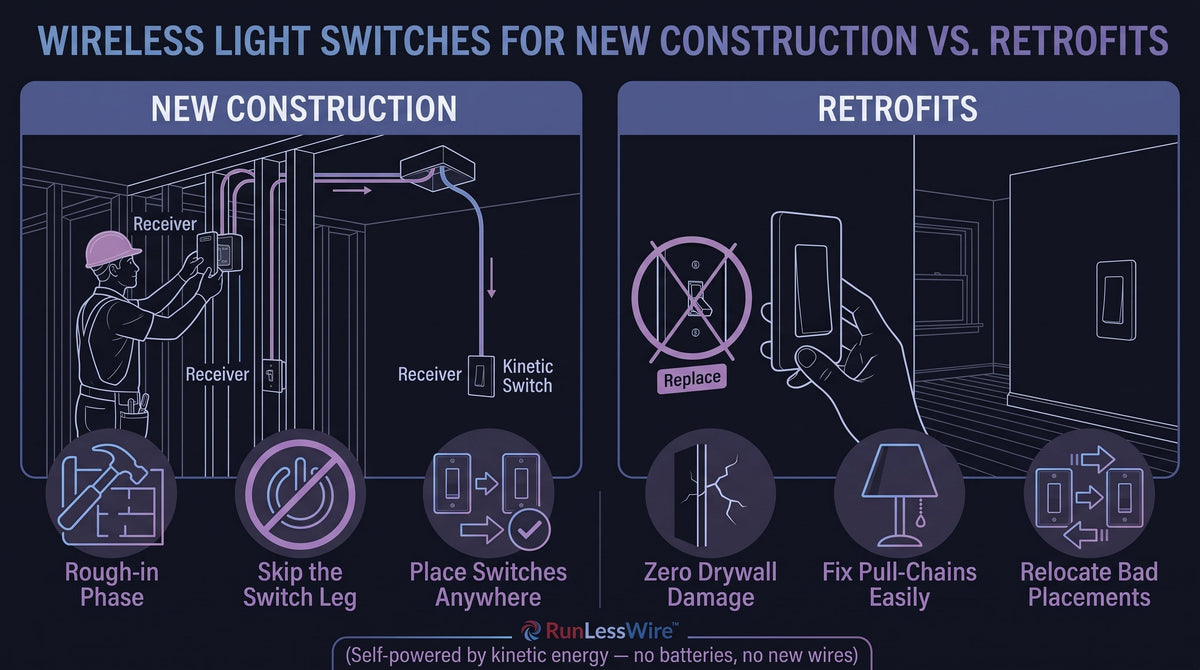
Whether you’re wiring a house from scratch or adding a switch to a 1950s bungalow, the basic value of a wireless switch is the same: you decouple the switch from the wiring behind it. A self-powered kinetic switch mounts anywhere; the receiver handles the load from wherever the wiring lives. Switch placement stops being a wiring decision — it becomes a design decision, driven by how people actually use the space.
2. In New Construction — Flexibility Before Drywall
For new builds, wireless switches solve two problems traditional wiring can’t. First, they eliminate traveler wires for 3-way and 4-way circuits — long staircases, hallways, or rooms with multiple entrances no longer need extra cable between switch boxes. Second, they let you finalize switch placement after the walls close, which happens more often than any electrician will admit. RunLessWire Wireless Switch Kits fit standard decora backplates, so they integrate with any modern aesthetic without looking like an afterthought.
3. In Retrofits — Where Traditional Wiring Can’t Go
Retrofits are where wireless switches earn their reputation. The bedroom without an overhead light. The hallway with a switch at one end only. The 1920s home with plaster walls and knob-and-tube runs that no one wants to touch. Wireless sidesteps all of it. You install a receiver at the existing switch or fixture location — the only spot that needs any wiring at all — and mount switches anywhere the signal reaches. No drywall opens, no cable gets fished, and no electrician gets called for anything past the receiver.
4. Multi-Location Control Without the Wiring Nightmare
Both new construction and retrofit projects run into the same wall with 3-way, 4-way, and control-from-anywhere setups: every additional switch means more traveler wire. Wireless makes those setups trivial. A single receiver supports up to 25 switches, all toggling the same load, all installed without any wire pulls between them. That’s a game-changer for open-concept homes, large primary bedrooms, and any space where “add a switch there too” comes up mid-project.
5. How to Decide
For retrofits, the choice is usually obvious: wireless is faster, cleaner, and less invasive than traditional rewiring in almost every scenario. For new construction, it’s a design conversation with your electrician. Use traditional wiring for the primary switch in each room — you’re wiring it anyway — and layer wireless in wherever the layout benefits: staircases, doorways, bedside additions, or any spot where a switch might move later. The two approaches aren’t mutually exclusive. The best-designed homes use both.
One System, Two Job Sites
What makes wireless valuable in either context is the same trait: it separates the question of where a switch goes from the question of where the wiring is. That freedom is useful during construction; it’s transformative after it.
Every RunLessWire product is engineered and assembled in the USA, backed by a 5-year warranty, and built to last 20+ years — long enough to outlive the paint on the walls it was installed behind.
No wires. No batteries. No limits.
Ready to plan your switches around your life?
Explore our full product line at runlesswire.com
or find us on Amazon and Home Depot.


Leave a comment
All comments are moderated before being published.
This site is protected by hCaptcha and the hCaptcha Privacy Policy and Terms of Service apply.